An Unearthly Series - The Origins of a TV Legend
Saturday, 4 May 2013 - Reported by John Bowman

 The tenth in our series of features looking at events leading to the creation of a true TV legend.
The story so far: After a number of meetings and reports within the BBC to decide on a new TV show to fill a scheduling gap late on Saturday afternoons, drama boss Sydney Newman has given the go-ahead for a science-fiction series of serials featuring four time-travellers. One of those travellers will be a mysterious, grumpy, frail, and elderly man on the run and cut off from his own distant civilisation. As the programme - still without a title - takes embryonic form, it has been decided that it will be made at Lime Grove, with recordings starting weekly on Friday 5th July 1963 and the transmission of the first of 52 episodes scheduled for Saturday 27th July.
Round about the beginning of May 1963 - 50 years ago this month - BBC staff director and producer Rex Tucker is placed in temporary charge of the programme while the search is made for somebody to take on the role of producer permanently. Tucker is a BBC veteran who has experience of classic serials and drama for children, and at a meeting with Newman he is told the format of the new series. With them is Richard Martin, who has recently finished the BBC's training course for directors, and the idea is that Tucker will helm the first serial and Martin other early ones.
During later talks, the fledgling show is finally given a name - Dr. Who - with Newman being credited as the person who came up with it
Script writer Cecil Edwin "Bunny" Webber had earlier drawn up an initial character and set-up plan. After some robust feedback from Newman, he now comes up with a draft document entitled General Notes on Background and Approach, aimed at potential writers for the show. Running to three and a half pages, it provides outlines for the four main characters, all of whom apart from the Doctor are given proper names for the first time. It also makes a bold suggestion as to how the space-time machine could be realised, gives the first episode its title, and describes the overall continuity of the series, its format, and what is being looked for in terms of stories.
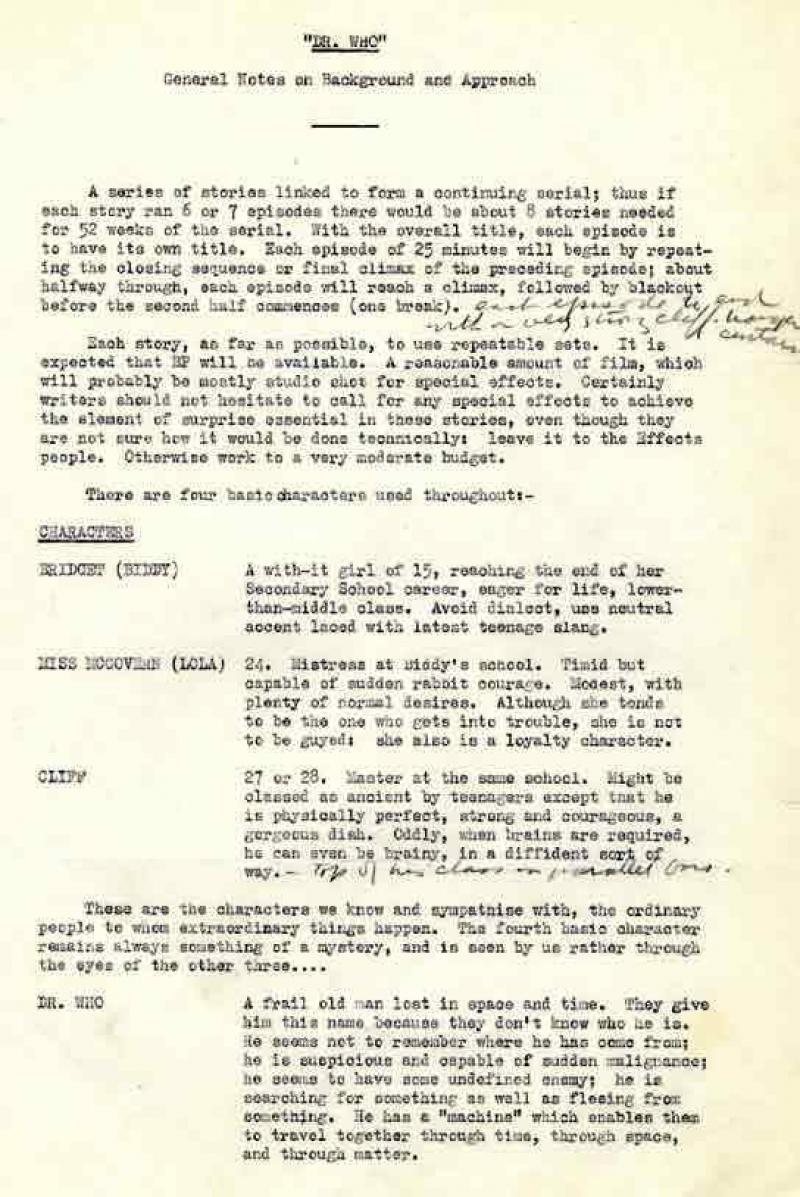
Page 2 of the format document, with hand-written annotations by Sydney Newman
Evidently, Dr. Who's "machine" fulfils many of the functions of conventional Science Fiction gimmicks. But we are not writing Science Fiction. We shall provide scientific explanations too, sometimes, but we shall not bend over backwards to do so, if we decide to achieve credibility by other means. Neither are we writing fantasy: the events have got to be credible to the three ordinary people who are our main characters, and they are sharp-witted enough to spot a phoney. I think the writer's safeguard here will be, if he remembers that he is writing for an audience aged fourteen... the most difficult, critical, even sophisticated, audience there is, for TV. In brief, avoid the limitations of any label and use the best in any style or category, as it suits us, as long as it works in our medium.
Granted the startling situations, we should try to add meaning; to convey what it means to be these ordinary human beings in other times, or in far space, or in unusual physical states. We might hope to be able to answer the question: "Besides being exciting entertainment, for 5 o'clock on a Saturday, what is worthwhile about this serial?"
DR. WHO'S "MACHINE"
When we consider what this looks like, we are in danger of either Science Fiction or Fairytale labelling. If it is a transparent plastic bubble we are with all the lowgrade spacefiction of cartoon strip and soap-opera. If we scotch this by positing something humdrum, say, passing through some common object in [the] street such as a night-watchman's shelter to arrive inside a marvellous contrivance of quivering electronics, then we simply have a version of the dear old Magic Door.
Therefore, we do not see the machine at all; or rather it is visible only as an absence of visibility, a shape of nothingness (Inlaid, into surrounding picture). Dr. Who has achieved this "disappearance" by covering the outside with light-resistant paint (a recognised research project today). Thus our characters can bump into it, run their hands over its shape, partly disappear by partly entering it, and disappear entirely when the door closes behind them. It can be put into an apparently empty van. Wherever they go some contemporary disguise has to be found for it. Many visual possibilities can be worked out. The discovery of the old man and investigation of his machine would occupy most of the first episode, which would be called:-
"NOTHING AT THE END OF THE LANE"
The machine is unreliable, being faulty. A recurrent problem is to find spares. How to get thin gauge platinum wire in B.C.1566? Moreover, Dr. Who has lost his memory, so they have to learn to use it, by a process of trial and error, keeping records of knobs pressed and results (This is the fuel for many a long story). After several near-calamities they institute a safeguard: one of their number is left in the machine when the others go outside, so that at the end of an agreed time, they can be fetched back into their own era. This provides a suspense element in any given danger: can they survive till the moment of recall? Attack on recaller etc.
- 3 -
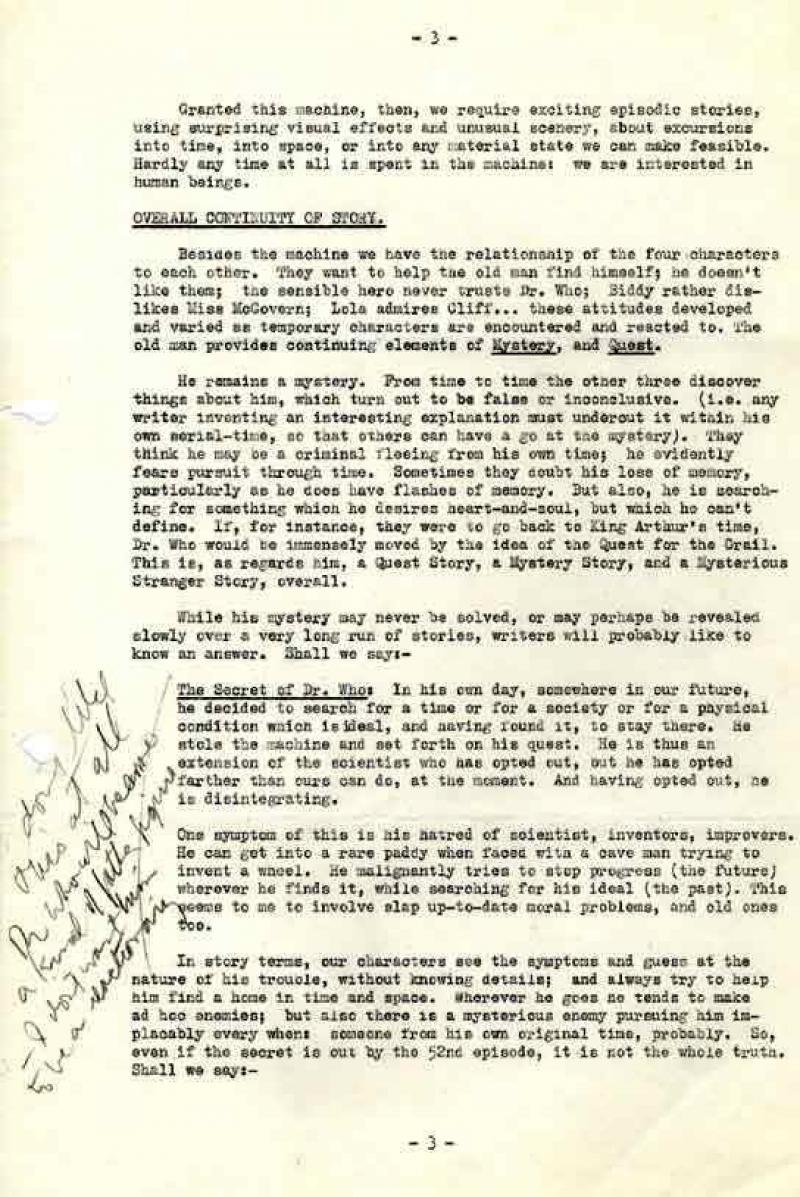
Page 4 of the format document, with hand-written annotations by Sydney Newman
The Second Secret of Dr. Who: The authorities of his own (or some other future) time are not concerned merely with the theft of an obsolete machine; they are seriously concerned to prevent his monkeying with time, because his secret intention, when he finds his ideal past, is to destroy or nullify the future.
If ever we get thus far into Dr. Who's secret, we might as well pay a visit to his original time. But this is way ahead for us too. Meanwhile, proliferate stories.
The first two stories will be on the short side, four episodes each, and will not deal with time travel. The first may result from the use of a micro-reducer in the machine which makes our characters all become tiny. By the third story we could first reveal that it is a time-machine; they witness a great calamity, even possibly the destruction of the earth, and only afterwards realize that they were far ahead in time. Or to think about Christmas: which seasonable story shall we take our characters into? Bethlehem? Was it by means of Dr. Who's machine that Aladin's [sic] palace sailed through the air? Was Merlin Dr. Who? Was Cinderella's Godmother Dr. Who's wife chasing him through time? Jacob Marley was Dr. Who - slightly tipsy, but what other tricks did he get up to that Yuletide?
One thing, however, that he is enthusiastic about is the time machine's inherent unreliability, writing "good stuff here" next to that section.
On the whole, though, Newman isn't keen on the proposed direction for the series. He writes: "I don't like this much. It all reads silly and condescending. It doesn't get across the basis of teaching of educational experience - drama based upon and stemming from factual material and scientific phenomena and actual social history of past and future. Dr Who - not have a philosophical arty - science mind - he'd take science, applied and theoretical, as being as natural as eating."
While Webber redrafts the format document to bring it more in line with Newman's vision, another name is thrown into the ring as a possible director on the new series. On Thursday 9th May, a memo is sent to script department boss Donald Wilson by children's programmes head Owen Reed (the actual Children's Department having been disbanded by Newman in January) urging him to consider Leonard Chase. Reed says Chase "has worked closely with Webber and has exactly the right flair for bold and technically adventurous 'through the barrier' stuff."
Four days later, it becomes apparent that (for undocumented reasons) the series' start has been put back to Saturday 24th August. On Monday 13th May, Drama Group Administrator Ayton Whitaker sends round a memo saying that recording will no longer begin on Friday 5th July, as was the original intention, but will now commence four weeks later on Friday 2nd August.


SOURCES: BBC Archive - The Genesis of Doctor Who; The Handbook (Howe, Walker, Stammers; 2005)